
Boost Holiday Traffic by Dec 2025 | UK Marketing Guide
Discover Christmas 2025 shopping marketing to capture peak seasonal demand, as UK festive campaigns drive over 40% of annual sales. Explore strategy tactics now.
MARKETING
Rudra Prakash Parida
12/9/202526 min read
My post content
Key Takeaway
The most successful Christmas shopping marketing strategies in 2025 don't push harder during peak season they build momentum earlier with the right content, optimize across multiple touchpoints, and leverage consumer behavior shifts that favour omnichannel experiences, AI personalization, and eco-conscious choices. By aligning your content with the buyer journey stages and adapting your messaging as the season progresses, you can capture both early planners and last-minute shoppers while maximizing ROI.
Table of Contents
Understanding the Christmas Shopping Marketing Opportunity in 2025
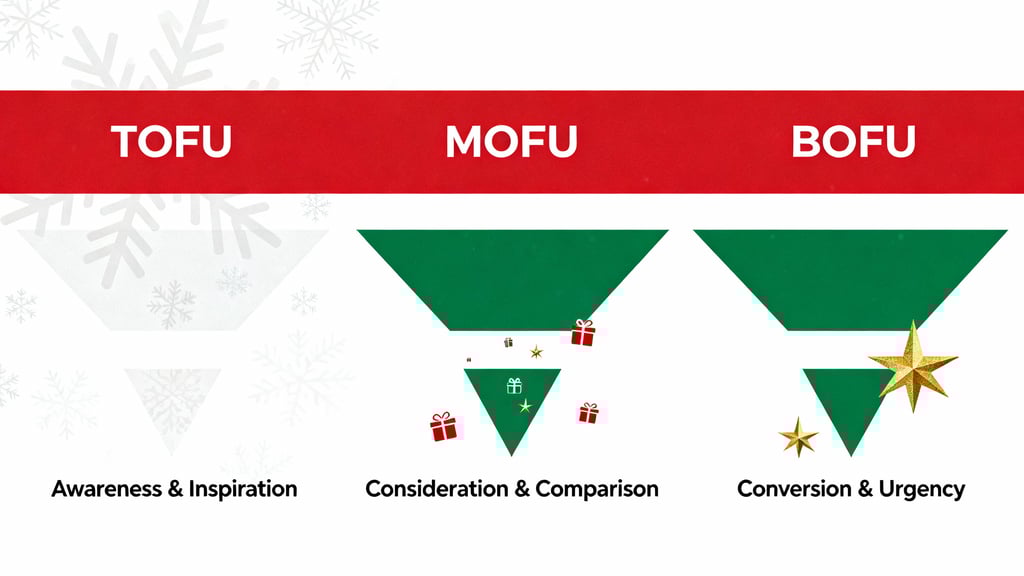
The Buyer Journey Stage Breakdown: TOFU, MOFU, BOFU
Content Strategy Timeline: What to Publish and When
Keyword Optimization for Christmas Shopping Intent
Building an Omnichannel Marketing Foundation
Personalization & AI-Driven Recommendations
Tactical Execution: Email, Social, Paid, and Organic
Cart Recovery and Conversion Optimization
Emerging Trends: Gen Z, Sustainability, and Secondhand Shopping
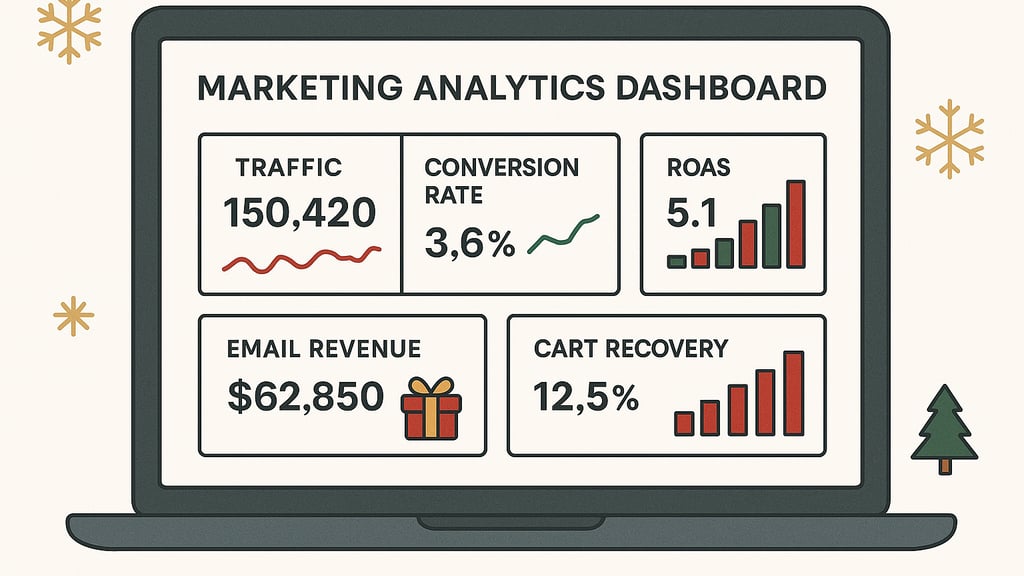
Measuring Success: KPIs and Performance Tracking
FAQ: Common Christmas Marketing Questions
Understanding the Christmas Shopping Marketing Opportunity in 2025
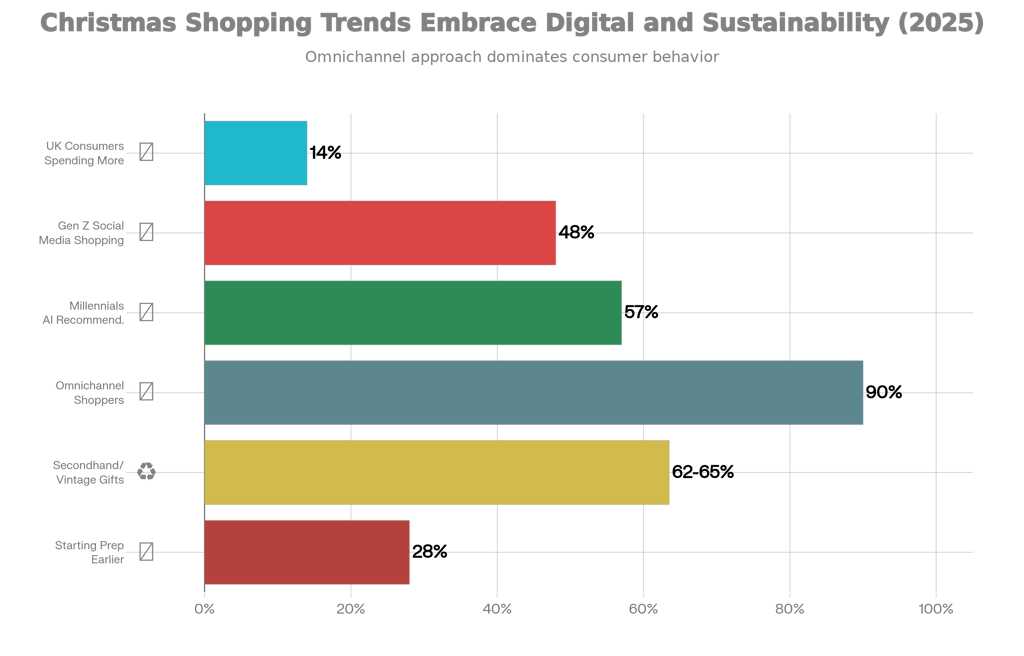
Christmas shopping represents the single largest revenue opportunity for most retailers, yet it's also the most competitive and time-sensitive marketing window of the year. In 2025, UK consumers plan to increase gift spending by 14% compared to previous years, and 28% are starting their holiday preparations earlier than ever before. This shift creates a strategic advantage for brands that can align their marketing efforts with evolving consumer behaviour rather than relying on last-minute, high-cost promotional blitzes.
The 2025 Christmas shopping landscape differs significantly from previous years due to five major shifts.
First, omnichannel shopping has become the norm 90% of consumers shop across multiple channels, blending online research, social media discovery, and physical store visits.
Second, younger generations (Gen Z and millennials) now represent the largest cohort of holiday shoppers, bringing different values around sustainability, authenticity, and AI-powered convenience.
Third, 23% of consumers already use AI tools to personalize gift recommendations, signalling a fundamental change in how shoppers discover products.
Fourth, the shift toward secondhand and vintage gifts (62-65% of younger shoppers) reflects both sustainability concerns and budget consciousness.
Fifth, holiday shopping now spans four months October through December rather than concentrating in November and December, requiring marketers to maintain campaigns with varying messaging throughout Q4.
Understanding these trends informs your overall strategy. Rather than a single "holiday campaign," successful Christmas shopping marketing in 2025 is a progressive series of interconnected campaigns that speak to different stages of the buyer journey, different audience segments, and different shopping occasions. This comprehensive approach maximizes awareness, builds consideration, and captures conversions across multiple touchpoints over an extended period.
The Buyer Journey Stage Breakdown: TOFU, MOFU, BOFU
Christmas shopping marketing success depends on matching your content, messaging, and tactics to where shoppers are in their decision-making process. The traditional buyer journey Top of Funnel (TOFU), Middle of Funnel (MOFU), and Bottom of Funnel (BOFU) applies directly to holiday marketing, though the timeline and tactics differ from standard B2B or everyday retail.
Top of Funnel (TOFU): Building Awareness and Inspiration
TOFU content educates potential customers about gift-giving challenges and solutions without directly promoting products. This stage typically runs throughout October and early November, when holiday shoppers are beginning to plan but haven't yet made purchase decisions. TOFU content answers questions like: "What are the best Christmas gifts for 2025?" "How do I plan a holiday budget?" "What trends should I know about?" and "How can I give more meaningful gifts?"
The goal at TOFU is to capture search traffic with informational keywords, build authority through comprehensive guides, and create the foundation for future remarketing campaigns. Examples of high-performing TOFU content include trend reports, gift guides organized by recipient (parents, teens, partners), budget-conscious shopping advice, and Christmas planning checklists. This content ranks well for broad, high-search-volume keywords and attracts shoppers early in their journey who aren't yet ready to purchase.
TOFU content should be optimized for keywords like "best Christmas gifts 2025," "Christmas gift ideas for [demographic]," "how to plan Christmas shopping budget," and "Christmas shopping trends." These keywords typically have lower conversion intent but massive search volume, and early engagement with these topics builds brand awareness and email list growth for later conversion stages.
Middle of Funnel (MOFU): Driving Consideration and Comparison
MOFU content helps shoppers evaluate options and compare solutions, addressing both product-specific questions and broader gift-giving decisions. This stage spans November through early December, when the urgency increases and shoppers move from inspiration to evaluation. MOFU keywords shift toward comparative intent: "best budget gifts under £50," "luxury Christmas gifts," "gift ideas for tech lovers," and "sustainable gift options,"
MOFU content includes detailed product reviews, comparison guides (e.g., "5 Best Wireless Headphones for Christmas"), bundle recommendations, price-tracking information, and personalized gift guides based on recipient interests or buyer preferences. The key difference from TOFU is that MOFU content actively guides shoppers toward your products or recommendations while still maintaining an educational tone. This is where testimonials, user-generated content, and proof elements (reviews, ratings, expert endorsements) become critical.
Black Friday and Cyber Monday strategies fit squarely in MOFU, as many shoppers use this period to evaluate whether they want to buy now or wait for better deals. MOFU content should address objections like pricing, shipping timelines, product quality, and value for money.
Real-world example: A beauty retailer might create MOFU content titled "The Ultimate Black Friday Beauty Guide: Our Top Recommendations," which compares products at full price and discounted price, explains why each item makes a great gift, and includes links to product pages.
Bottom of Funnel (BOFU): Driving Conversions and Urgency
BOFU content explicitly encourages purchase decisions and removes final friction points. This stage dominates from mid-December through Christmas, when shoppers have decided to buy but need immediate solutions. BOFU keywords are highly transactional: "buy [product name] online," "[product] free shipping," "last-minute Christmas gifts," "digital gift ideas," and "express delivery."
BOFU content includes last-minute gift ideas, final sale announcements, urgency-driven messaging (countdown timers, "order by December 20th for guaranteed Christmas delivery"), digital gift alternatives (gift cards, subscriptions), and simplified one-click purchasing options. BOFU content should minimise friction and maximise perceived value, using elements like payment flexibility (BNPL options), free returns until January, gift wrapping services, and exclusive final-day deals.
The messaging at BOFU shifts dramatically from TOFU. Instead of "explore your options," BOFU messaging says "act now to guarantee Christmas delivery" or "last 48 hours for guaranteed arrival." Real-world example: An online retailer running a BOFU email campaign might use the subject line "Final 24 Hours: Order Now & Receive by Christmas [with Free Returns Till Jan 15]," focusing entirely on urgency and risk removal rather than product benefits.
Content Strategy Timeline: What to Publish and When
A strategic content calendar ensures you're reaching shoppers at the right time with the right message throughout the Christmas shopping season. The seasonal content strategy differs fundamentally from evergreen content, requiring careful timing to align with consumer behaviour shifts and competitive intensity.
October: Educational Content & Early Planning
October is when Christmas shopping marketing truly begins, though many brands don't activate until November. Early movers in October capture "Christmas gift idea" searches with lower competition and build authority that compounds through November and December. October content should focus on education, inspiration, and planning.
Key content types for October:
Comprehensive Christmas gift guides organized by recipient (parents, teenagers, partners, friends, colleagues)
2025 Christmas shopping trends and predictions
Budget-planning guides and strategies
Timely lifestyle content (e.g., "Cozy Gift Ideas for Cold Months")
How-to content (e.g., "How to Pick the Perfect Gift" or "How to Personalize Gifts")
Early access announcements and preview content
Email list growth campaigns and lead magnets
Real-world tactic: A homeware retailer might publish "The 2025 Christmas Entertaining Guide: Must-Have Items for Holiday Hosting," which ranks for broad gift-giving keywords, generates email signups, and establishes the brand as a thought leader before peak season competition arrives. This single comprehensive piece generates significant long-tail traffic (e.g., "Christmas tablecloths," "festive dishware," "holiday candles") that converts throughout November and December.
October content should adopt a broad, informational tone. Avoid heavy promotional messaging; instead, focus on providing genuine value and answering questions your audience is actually asking. Primary keyword focus: "Christmas gifts 2025," "best Christmas gift ideas," "Christmas shopping guide," "gift ideas for [demographic]," long-tail variations like "unique Christmas gifts for mum."
November: Conversational & Price-Driven Content
November is when holiday shopping volume spikes, triggered by Black Friday and Cyber Monday. Consumer behaviour shifts from "exploring options" to "comparing prices and evaluating deals," and your content strategy must reflect this urgency. November content maintains educational value but adds explicit value propositions and promotional elements.
Key content types for November:
Black Friday and Cyber Monday guides and deal alerts
Product comparison articles (e.g., "5 Best Luxury Gift Sets Under £100")
Price-tracking guides (e.g., "Which Gifts Are Actually on Sale This Black Friday?")
Deal roundups and curated product lists
Budget-conscious gift guides
Subscription and gift card content
Retargeting campaigns for engaged October visitors
SMS and email sequences for list subscribers
Messaging tone shifts: October messaging sounds like "Explore these amazing gift ideas," while November messaging becomes "Here's where to find the best deals on gifts your recipients will love" or "These items are worth buying before they sell out."
Real-world example: A tech retailer publishes "Black Friday Tech Gift Guide: Best Deals on AirPods, iPads, and Smartwatches," combining MOFU comparison content with transactional keywords and deal-focused messaging.
November is when omnichannel content coordination becomes critical. Your website, email, social media, and paid advertising should all reinforce the same deals, bundles, and offers. Primary keyword focus: "Black Friday gifts," "Cyber Monday deals," "[product] discount," "gift bundles," "Christmas deals," "where to buy [product]."
Early December (Dec 1-15): Product-Specific & Personalization Content
Early December shifts content strategy toward specificity and personalization. While November was about communicating deals broadly, early December content helps shoppers who've already decided to buy find the exact right product for their specific needs. Content becomes more segmented, addressing specific customer segments, product categories, and gift occasions.
Key content types for early December:
Personalized gift guides (by budget, recipient age, interests, lifestyle)
Detailed product reviews and comparisons (narrower in scope than November)
How-to guides for specific products (e.g., "How to Choose the Right Smartwatch")
Category deep-dives (e.g., "The Complete Wellness Gift Guide")
Video content and unboxing guides
Influencer collaborations and gift recommendations
Customer testimonial and social proof content
Bundled product recommendations
Sponsored content and partnerships
Messaging at this stage becomes highly personalized and benefit-focused. Rather than broad "best gifts" content, this stage includes "gifts for the person who has everything," "last-minute gifts that still feel thoughtful," and "gift ideas for different budgets."
Real-world example: A luxury retailer creates "The Ultimate Luxury Gift Guide for Christmas 2025," featuring high-end items, lifestyle photography, and detailed product descriptions targeting affluent shoppers ready to make premium purchases.
Primary keyword focus: Specific product names, brand comparisons, "best [product type] for [recipient]," budget-specific keywords like "premium gifts," "affordable gifts under £50," review keywords like "[product] review," "does [product] work?"
Mid-December to Christmas (Dec 16-25): Urgency & Delivery-Focused Content
The final stretch of Christmas shopping requires a sharp pivot toward urgency and last-minute solutions. Consumer behaviour at this stage is driven by immediate need: they've procrastinated and need guaranteed delivery, or they need digital solutions that bypass shipping delays. Content and messaging should emphasize convenience, speed, and certainty.
Key content types for mid-December:
Last-minute gift guides (curated for quick decision-making)
Digital gift guides (gift cards, subscriptions, e-books, streaming access)
Express delivery and click-and-collect guides
Urgency-driven limited-time offers
Final clearance and last-stock alerts
Gift wrapping and presentation guides
Returns policy transparency (risk removal)
Same-day delivery or local pickup options
Messaging becomes explicitly urgent. Email subject lines shift from informative "Guide to the Best Christmas Gifts" to action-oriented "Final 24 Hours: Order Now for Guaranteed Christmas Delivery". Social media content emphasizes stock urgency like "Only 3 Left in Stock!" and delivery certainty "Order by Midnight for Tomorrow Delivery" .
Real-world example: A fashion retailer's December 20th email reads, "Last 4 Days Guaranteed Delivery: Final Call on Our Most-Loved Gifts [Free Returns Till Jan 15]," combining urgency with risk removal messaging.
Primary keyword focus: "Last-minute gifts," "digital gifts," "gift cards," "[product] in stock," "next-day delivery," "same-day delivery," "Christmas gifts arrive by," delivery-related keywords.
Keyword Optimization for Christmas Shopping Intent
Keyword strategy sits at the core of Christmas shopping marketing success. Unlike evergreen keyword targeting, seasonal keywords require strategic timing and alignment with buyer journey stages. Effective Christmas shopping keyword optimization targets 1-1.5% keyword density, avoiding over-optimization while ensuring natural, conversational language that resonates with both search engines and readers.
Primary Keywords: Core Gift-Giving Intent
Your primary keywords should align with your main product categories and appear in your H1 title, meta description, first 100 words, and URL slug. For a general retailer, primary keywords might be "Christmas shopping strategy," "Christmas gift ideas," or "Christmas marketing strategy," while category-specific retailers target "luxury Christmas gifts," "sustainable gift ideas," or "last-minute Christmas gifts."
Place primary keywords naturally in:
H1 title (first 50 characters): "The Ultimate Christmas Shopping Marketing Strategy: Convert Shoppers at Every Stage"
Meta description (145-155 characters): "Master Christmas shopping marketing with proven strategies for omnichannel success, personalization, and 2025 consumer trends. TOFU-BOFU tactics."
First paragraph (first 100 words): Naturally mention "Christmas shopping marketing strategy" within the opening context-setting paragraph
URL slug (under 75 characters): /christmas-shopping-marketing-strategy-2025
Primary keyword target density: 1-1.5% of total word count. For a 3,500-word article, this means "Christmas shopping" or related primary keyword phrases should appear 35-52 times across the entire piece. Spread these mentions evenly across sections rather than concentrating them in the opening.
Secondary Keywords: Intent-Specific Search Phrases
Secondary keywords target specific aspects of Christmas shopping and should appear in H2 and H3 subheadings throughout your content. Secondary keywords for a Christmas shopping marketing article might include:
"Christmas shopping trends 2025"
"Omnichannel Christmas marketing"
"Black Friday marketing strategy"
"Gift guide content marketing"
"Holiday email marketing"
"Last-minute Christmas shopping"
Each H2 and H3 heading should naturally incorporate one secondary keyword. Rather than forcing keywords into headings, ensure your heading genuinely reflects the section's content while containing the keyword phrase.
Long-Tail Keywords: Capturing Niche Queries
Long-tail keywords (typically 3-5+ words) capture specific, lower-volume but higher-intent searches. Long-tail keyword examples for Christmas shopping include:
"Best Christmas gifts for people with everything"
"How to optimize Christmas shopping budget"
"Eco-friendly sustainable Christmas gift ideas"
"Christmas shopping deals for budget shoppers"
"How to personalize Christmas gift recommendations"
"Omnichannel strategy for holiday retail"
Weave long-tail keywords naturally throughout body paragraphs. Long-tail variations feel more conversational and match how people actually search using voice assistants or AI tools. A single section might include multiple long-tail variations addressing the same core topic (e.g., "sustainable gift ideas," "eco-friendly Christmas gifts," "green gift alternatives").
Semantic Keywords: Topic Depth & Context
Semantic keywords are conceptually related terms that signal topical authority without being keyword variants. Semantic keywords for Christmas shopping marketing include:
Consumer behaviour, buyer journey, shopper psychology
Omnichannel, multichannel, integrated marketing
Personalization, segmentation, customer data
Conversion optimization, cart recovery, urgency tactics
Generational trends, Gen Z, millennials
Sustainability, ethical consumption, secondhand
Search engines increasingly use semantic understanding to evaluate content quality. Including semantic keywords (without forcing them) demonstrates that you've thoroughly explored the topic. These keywords naturally integrate into discussions of buyer psychology, marketing channels, and consumer trends.
Keyword Placement Strategy by Buyer Stage
Different buyer stages call for different keyword emphasis:
TOFU keywords (October): Broad, informational keywords like "Christmas gift ideas," "gift guides," "gift inspiration"
MOFU keywords (November): Comparative keywords like "best gifts under £X," "gift comparisons," "product reviews," deal-focused keywords
BOFU keywords (December): Transactional keywords like "buy online," "next-day delivery," "in stock," "digital gifts"
Aligning keyword strategy with buyer stage ensures your content attracts shoppers ready to take the action your article encourages.
Building an Omnichannel Marketing Foundation
The evolution of Christmas shopping from a single-channel activity (primarily in-store during November-December) to an omnichannel journey spanning four months across social media, search, email, apps, and physical stores fundamentally reshapes marketing strategy. 90% of holiday shoppers now blend online research, social media discovery, and physical store visits, requiring brands to create seamless, integrated experiences across every touchpoint.
Understanding the Modern Omnichannel Shopper
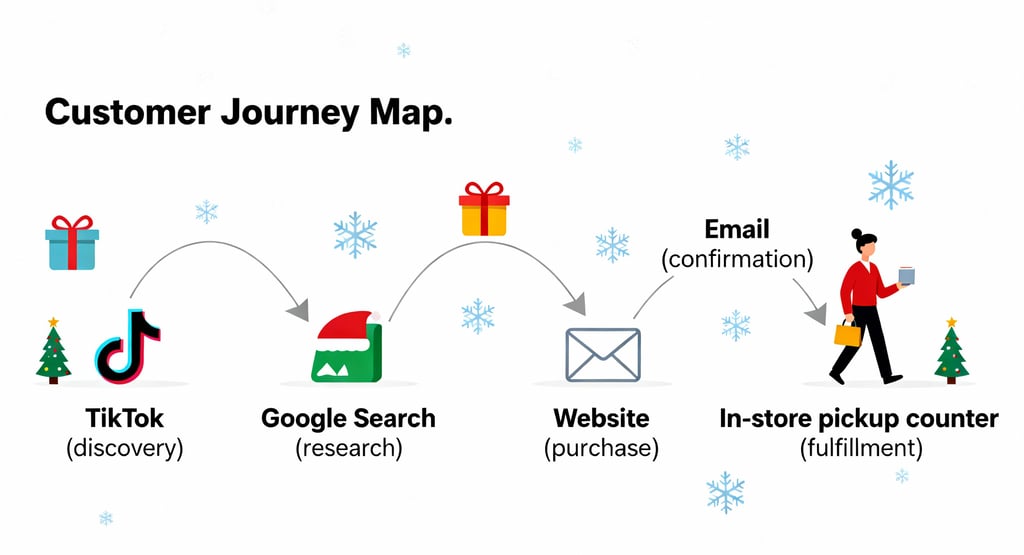
Today's Christmas shopper doesn't follow a linear path. A typical journey might look like:
discovery on TikTok or Instagram (inspired by influencer content) → Google search for specific products and prices → website browsing and product research → email signup for deal alerts → Black Friday email sequence → cart abandonment → retargeting ad that encourages click-and-collect → in-store pickup with additional impulse purchases. This non-linear, touchpoint-rich journey requires marketing coordination across channels.
Crucially, 81% of Gen Z shoppers get gift inspiration from in-store displays, even when they ultimately purchase online. This means your in-store experience, window displays, and local presence influence digital shoppers. Similarly, social media content (particularly TikTok, Instagram Reels, and Pinterest) drives research and comparison behaviour that converts on your website or in physical stores.
Strategic Channel Selection & Prioritization
Rather than attempting to maintain identical messaging across every platform, successful omnichannel strategy aligns each channel with where it's most effective:
Discovery & Inspiration Channels (top-of-funnel):
Instagram and TikTok for visual storytelling and trend-setting
Pinterest for aspirational gift ideas and lifestyle inspiration
YouTube for reviews, unboxing, and educational content
Influencer partnerships and user-generated content
Research & Comparison Channels (mid-funnel):
Google search and Google Shopping for product research and price comparison
Your brand website with detailed product information and reviews
Facebook for targeted discussions and community recommendations
Email newsletters with curated recommendations
Conversion & Purchase Channels (bottom-funnel):
Google Shopping and retail media networks for transactional keywords
Email with direct product links and exclusive offers
Retargeting ads on social platforms and the display network
In-store for final purchase and impulse buying
Real-world example: A beauty brand notices Gen Z audience engagement heavily on TikTok but conversion primarily on Google and in-store. Rather than splitting budget evenly, they allocate 40% to TikTok for awareness-building (video reviews, trending content, influencer partnerships), 35% to Google Shopping for direct conversion (product ads, reviews), and 25% to coordinated retargeting across Meta and in-store. This channel-specific allocation maximizes overall ROI.
Consistency With Flexibility: The Core-Variant Approach
Omnichannel messaging shouldn't mean identical messaging everywhere. Instead, maintain a consistent core brand narrative and offer, then adapt the format and tone to each platform:
Core narrative: "Thoughtful gifts that feel personal" (consistent across channels)
TikTok variant: Trend-forward video content showing product in lifestyle context (energetic, authentic, behind-the-scenes)
Pinterest variant: High-quality product images with lifestyle context and gift-giving tips (inspirational, aspirational)
Email variant: Direct product recommendations with personalization (benefit-focused, clear CTAs)
In-store variant: Bundled displays, staff recommendations, same-day purchase incentives (convenient, immediate)
This approach prevents message fatigue while maintaining brand coherence. Shoppers see the same brand value ("thoughtful, personal gifts") across channels but experience it in formats optimized for each platform's audience and usage patterns.
Integrating Online & Offline: The Click-and-Collect Advantage
Click-and-collect represents a critical omnichannel bridge: shoppers research online but complete purchases in-store, avoiding shipping delays and fees while generating foot traffic that drives impulse purchases. Research shows that click-and-collect customers often spend 20-30% more than anticipated due in-store impulse buying.
Marketing click-and-collect services effectively requires prominent messaging across digital channels (on product pages, in email campaigns, during checkout) and consistent in-store signage. During December, messaging should emphasize the specific advantage: "Order Online Today, Pick Up Tomorrow [Guaranteed Before Christmas]."
Personalization & AI-Driven Recommendations
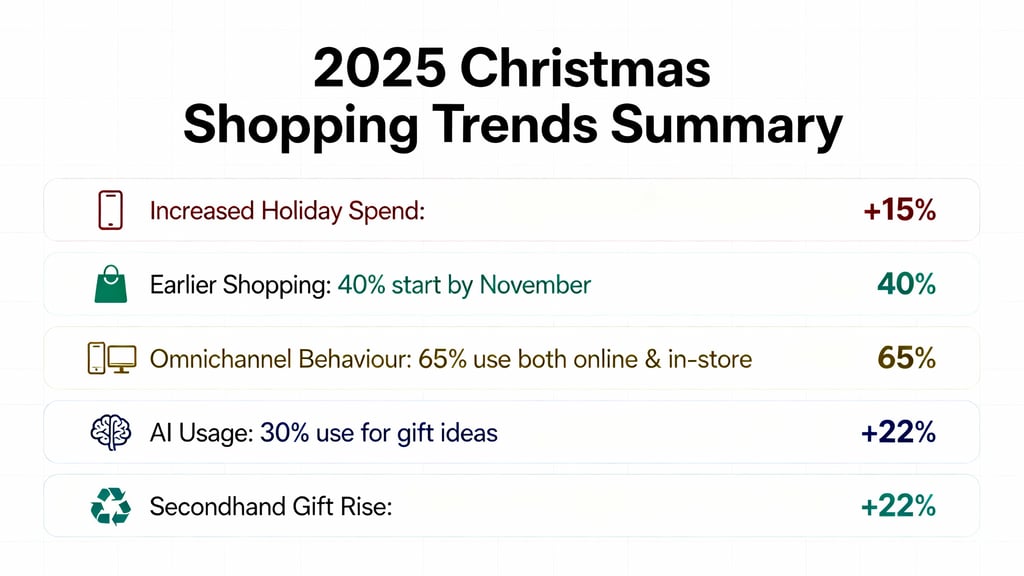
Personalization has evolved from a nice-to-have marketing enhancement to a fundamental expectation. Over 70% of holiday shoppers expect personalized experiences, and 61% of Gen Z actively use AI tools to help them shop and find thoughtful gifts. Brands that fail to personalize risk higher bounce rates and lost conversions. 2025 Christmas Shopping Trends & Consumer Behavior - Key statistics showing how shoppers are evolving their holiday purchasing patterns this year
Building Effective Personalization: Data Segmentation
Personalization begins with strategic customer segmentation using first-party data. Create segments based on:
Shopping Behaviour:
Bargain hunters (historically purchase discount items)
Premium buyers (consistently buy higher-priced items)
Seasonal shoppers (only shop during sales events)
Year-round customers (regular purchasers)
Product Preferences:
Electronics enthusiasts
Fashion & accessories focused
Home & lifestyle buyers
Experience gifters (events, subscriptions)
Purchase History:
First-time customers
2-3 time repeat customers
Loyal customers (4+ purchases)
Lapsed customers (haven't purchased in 6+ months)
Engagement Level:
Highly engaged (frequent opens, clicks, website visits)
Moderately engaged (occasional interactions)
Low-engagement (minimal interaction)
New subscribers (first 30 days)
Once segmented, tailor content, product recommendations, and offers to each group:
Bargain hunters receive gift guides highlighting "luxury items on sale" and budget-conscious options
Premium buyers receive exclusive early access, higher-end curations, and VIP offers
Repeat customers receive loyalty rewards and personalized recommendations based on past purchases
Lapsed customers receive targeted re-engagement offers with special incentives
Real-world example: An online fashion retailer segments their Christmas campaign by past purchase data. Customers who previously bought jewellery receive a "Jewellery Gift Guide" email, while customers with a history of purchasing activewear receive an "Athleisure Gift Guide" email. Open rates on these personalized campaigns exceed 40%, compared to 15-20% for generic seasonal emails.
AI-Powered Recommendations at Scale
Modern AI tools analyze customer data across multiple dimensions browsing history, purchase history, demographic info, engagement patterns, current trends to deliver real-time product recommendations. These recommendations can be integrated across your website (homepage recommendations, product page bundles, checkout upsells), email campaigns, and even social ads.
Key AI recommendation strategies for Christmas shopping:
Homepage personalization: Returning visitors see a personalized homepage featuring products relevant to their interests and purchase history, rather than a static homepage everyone sees. This simple change can increase conversion rates by 20-30%.
Product page smart bundles: Shoppers viewing a cashmere sweater automatically see bundles pairing it with complementary items (scarves, jewellery, outerwear) curated to their style preferences.
Email product recommendations: Rather than the same product recommendations for all subscribers, AI generates unique recommendations for each recipient based on their browsing and purchase data. A subscriber who frequently views beauty products receives different recommendations than one who primarily looks at tech.
Dynamic retargeting ads: Shoppers who abandoned carts see retargeting ads featuring exactly the products they left behind, personalized by device, time of day, and user behaviour.
Privacy-First Personalization: Building Trust
Personalization effectiveness depends entirely on consumer trust. Transparent data practices build trust, while invasive or seemingly "creepy" personalization destroys it. Maintain privacy-first personalization by:
Communicating data practices clearly: Explain in accessible language how you collect data and what you use it for
Respecting user preferences: Offer granular privacy controls allowing customers to opt out of personalization while remaining customers
Securing customer data: Implement robust security measures and communicate these efforts
Avoiding over personalization: Some personalization feels inappropriate (e.g., product recommendations based on very recent sensitive searches). Use judgment to ensure recommendations feel helpful rather than invasive
Privacy regulations like GDPR and emerging AI transparency requirements make this practice both ethical and legally necessary. Customers increasingly expect brands to be transparent about AI use, and doing so actually builds loyalty rather than reducing it.
Tactical Execution: Email, Social, Paid, and Organic
Strategic frameworks mean little without tactical excellence. This section details how to execute Christmas shopping marketing across the four primary channels: email, social media, paid advertising, and organic search.
Email Marketing: Building the Engine
Email remains the highest-ROI marketing channel for Christmas shopping, generating average returns of £30-40 for every £1 spent. Strategic email execution requires building a pipeline of engaged subscribers throughout October and November, then deploying coordinated sequences in late November and December.
Email strategy by stage:
October emails (TOFU - awareness building):
Welcome series for new subscribers (3-5 emails over 2 weeks)
Educational content (gift guides, trends, planning tips)
Early-access previews for loyal subscribers
Subscriber-only discounts (incentive for list building)
Monthly trend roundup or inspiration email
Target frequency: 2-3 emails per week
November emails (MOFU - comparison & decision):
Black Friday teaser sequence (5-7 emails over 10 days)
Exclusive early access for subscribers
Segment-specific deal alerts (different offers for different customer segments)
Reminder emails (targeted at unopened emails from previous sends)
Social proof content (customer reviews, testimonials)
Target frequency: 3-5 emails per week during Black Friday/Cyber Monday
December emails (BOFU - urgency & conversion):
Last-minute gift guides
Urgency-driven limited-time offers
Cart abandonment sequences (1-3 emails within 48 hours)
Inventory alerts (stock running low)
Final-day offers and digital alternatives
Target frequency: Daily emails during final week before Christmas (but respect frequency caps and unsubscribe requests)
Email optimization essentials:
Subject lines: Include personalization, urgency, or benefit when appropriate. "Your Personal Gift Guide: [Name]" outperforms "2025 Christmas Gift Ideas." During December, "[First Name], Last 24 Hours for Guaranteed Delivery" drives higher urgency-based action.
Preview text: Use the 40-60 character preview text (the snippet visible before opening) to reinforce subject line or add missing information.
Send time optimization: Test optimal send times for your specific audience. Most gift shoppers check email between 10am-2pm on weekdays, but your data might differ.
Segmentation and personalization: Beyond recipient name, segment by purchase history, product preferences, and engagement level. "Complete your gift list with these trending items for [segment name]" significantly outperforms generic recommendations.
Mobile optimization: 60%+ of email opens occur on mobile. Ensure your email template displays beautifully on small screens, with large buttons (minimum 44px tap targets) and concise copy.
Real-world email case study: A UK home goods retailer segments their November email list into five groups based on purchase history: (1) budget shoppers (under £50 average purchase), (2) mid-range buyers (£50-150), (3) premium customers (£150+), (4) first-time buyers, (5) lapsed customers (no purchase in 12 months). Each segment receives different gift guides, discount offers (20% for budget buyers, 15% for mid-range, 10% for premium), and messaging tone. The premium segment receives language emphasizing exclusivity and quality; the budget segment emphasizes value and smart spending. Result: 35% higher click-through rates and 40% higher conversion rates compared to undifferentiated campaigns.
Social Media: Driving Discovery & Engagement
Social platforms serve different functions in the Christmas shopping journey. Instagram and TikTok drive awareness and inspiration (TOFU), Facebook enables targeted mid-funnel campaigns and community building, LinkedIn reaches B2B gift-buyers, and Pinterest captures long-term inspiration searches that convert to purchases months later.
Platform-specific tactics:
Instagram (visual brand presence):
Feed posts showcasing gift ideas in lifestyle contexts (3-4x per week)
Instagram Reels featuring quick gift guides, trend overviews, or entertaining holiday content (daily, trending sounds increase reach)
Instagram Stories with polls, quizzes, and product showcases (2-3x daily during peak season)
Shoppable posts linking directly to gift products (tested extensively in October for October relevance)
Influencer partnerships and takeovers (guest influencers create content driving their audience to your brand)
User-generated content sharing (repost customer gift photos, build community)
TikTok (trend-forward discovery):
Authentic, trend-following content (jumping on trending audio, formats, hashtags)
Gift unboxing and review content (short-form, entertaining format)
Behind-the-scenes packaging and fulfillment (humanizes brand, builds trust)
Duet and stitch collaborations (amplify reach through native TikTok features)
Hashtag challenges encouraging user-generated gift content (#MyPerfectGift or similar)
Influencer partnerships (micro-influencers often outperform macro for TikTok engagement)
Target frequency: 3-5 TikToks per week
Facebook (community & targeting):
Targeted gift guide carousel ads (visual ad format perfect for multiple products)
Dynamic ads showing exactly the products users abandoned or viewed on your website
Facebook Groups for community building (brand loyalists discussing gift ideas, sharing reviews)
Event promotion (holiday sales events, live shopping sessions)
Testimonial and social proof content (customer reviews, before/after results if applicable)
Pinterest (long-term inspiration & traffic):
High-quality product and lifestyle pins (1200x1500px vertical format performs best)
Idea pins (video-style, carousel pins) showing styling, unboxing, or gift guides
Seasonal pin designs (pin design changes for October, November, December capture seasonal interest)
Rich pins with product information, price, and availability (enable direct shopping from Pinterest)
Consistent pinning schedule (3-5 pins daily, including a mix of new content and repins)
Email/SMS to social coordination:
Include social sharing buttons in emails (make it easy for recipients to share gift guides with friends)
Promote social-exclusive offers and content (early access to followers, exclusive discount codes for social media fans)
Use social reviews and testimonials in email campaigns (screenshot positive social proof from Instagram comments, TikTok videos)
Paid Advertising: Strategic Channel Allocation
Paid advertising during Christmas shopping peaks at extreme cost (high CPM, high CPC, high CAC), making strategic budget allocation critical. Rather than spreading budget evenly, concentrate spending during high-efficiency windows and scale back during expensive periods.
Paid advertising strategy by month:
October paid strategy:
Start small with brand awareness campaigns on Instagram and TikTok (build warm audiences for later retargeting)
Early search campaigns targeting informational keywords ("best Christmas gifts," "gift ideas")
Remarketing (retargeting) earlier website visitors
Budget allocation: 30% awareness (broad targeting), 50% search, 20% remarketing
Expected CPC: £0.40-0.80 (lower than November/December)
November paid strategy:
Scale search campaigns aggressively (high intent, still reasonable CPC compared to December)
Expand social ads to Facebook with deal/bundle promotion
Launch display remarketing to earlier visitors
Allocate significant budget during final week before Cyber Monday (conversion peak)
Scale back during the expensive final days of Cyber Monday (CPC peaks; pull back unless ACoS is still acceptable)
Budget allocation: 20% awareness, 50% search and shopping, 30% remarketing
Expected CPC: £0.80-1.50
December paid strategy:
Shift focus to remarketing and warm audience targeting (cold traffic becomes prohibitively expensive)
Heavy search retargeting for cart abandoners
Last-minute gift guides and urgency-focused ads
Final-week heavy promotions push budget (this is highest intent, but also highest competition)
Budget allocation: 10% awareness, 30% search, 60% remarketing/warm audiences
Expected CPC: £1.50-3.00+
Platform-specific paid tactics:
Google Shopping ads: These product ads appear at the top of search results when shoppers search for specific products. Google Shopping is essential for capturing high-intent traffic, but CPCs rise dramatically in December. Strategy: Start with broad campaigns in November, then narrow targeting in December to highest-converting products and keywords to maximize ROI.
Retail media networks: Amazon Ads, Walmart Connect, Tesco Clubcard+ Ads (growing) allow brands to advertise directly to shoppers within retailer ecosystems. These platforms offer first-party purchase data and high-intent audiences. Allocate 15-20% of paid budget to retail media networks if selling through these channels.
Social retargeting campaigns: Use pixel data to target users who visited your website without purchasing. Serve them dynamic ads showing the exact products they viewed or abandoned, or complementary products. Retargeting audiences cost 60-70% less than cold audiences.
Paid newsletter sponsorships: During peak season, sponsored placements in relevant newsletter reach engaged gift shoppers. A sponsored placement in a popular gift guide newsletter (e.g., a lifestyle or shopping newsletter) costs £500-2,000 but reaches highly qualified prospects.
Organic Search: Foundation Building for Year-Round Results
Organic search (SEO) is a long-term investment with Christmas shopping benefits extending well beyond December. Content you publish in October ranks increasingly better throughout November and December, driving compounding traffic and conversions.
Organic search strategy for Christmas shopping:
Content production timeline:
June-August: Analyze competitor content, identify high-opportunity gift guide topics, plan 10-15 comprehensive guides
September-October: Publish comprehensive gift guides, trends content, planning guides (these rank by November/December)
November-December: Publish updating content, new guides based on emerging trends, and tactical conversion-focused content
Link building and authority development:
Outreach to complementary brands and gift guides for collaboration and cross-links
Guest post opportunities on high-authority lifestyle and shopping blogs
PR outreach for press coverage (seasonal trend stories generate backlinks)
Internal linking: Link relevant blog posts to each other, creating topical clusters
Featured snippet optimization:
Structure FAQ sections with clear question/answer format (targets voice searches)
Use tables for product comparisons (featured snippets often feature tabular data)
Include bullet-point summaries and definitions
Mobile and Core Web Vitals optimization:
Test page speed using PageSpeed Insights; aim for green scores (under 3 seconds load time on 4G)
Implement lazy loading for images
Compress images before upload
Minimize CSS and JavaScript
Emerging Trends: Gen Z, Sustainability, and Secondhand Shopping
Christmas shopping in 2025 differs from previous years in three fundamental ways: generational shifts in who's doing the shopping, sustainability values reshaping purchase decisions, and the normalization of secondhand and vintage gift-giving.
Gen Z Takes the Lead: Implications for 2025
For the first time in UK Christmas shopping history, millennials represent the largest generation making holiday purchasing decisions, with Gen Z rapidly closing behind. This generational shift has profound implications for marketing strategy, values, and channel preference.
Gen Z characteristics shaping Christmas shopping:
Authenticity over polish: Gen Z values real, authentic brand communication over polished corporate messaging. Brands using genuine employee voices, unfiltered social content, and transparent practices resonate more than those with heavily produced campaigns. TikTok's organic, trend-following content format appeals to Gen Z far more than traditional Facebook advertising.
Social consciousness: 73% of Gen Z consumers are willing to pay more for sustainable products. Environmental impact and ethical practices significantly influence purchase decisions. Brands highlighting sustainable materials, ethical manufacturing, and social impact messages capture Gen Z mindshare and loyalty.
Personalization and AI enthusiasm: Rather than feeling invasive, AI-powered recommendations feel helpful to Gen Z. 61% of Gen Z use AI tools for gift recommendations, and 51% trust AI recommendations more than their own judgment. Brands integrating AI personalization, gift recommendation tools, and AI-powered shopping experiences appeal directly to Gen Z values.
Community-driven shopping: Gen Z trusts peer recommendations (via social media, reviews, influencer endorsements) more than traditional advertising. User-generated content, influencer partnerships, and community discussions significantly influence purchase behaviour. A product featured in a relatable TikTok creator's gift guide influences Gen Z purchasing more than a traditional ad.
Omnichannel comfort: Gen Z seamlessly moves between social discovery, online research, and in-store shopping without hierarchy. They're equally likely to discover a gift via Instagram, research it via Google reviews, and complete purchase in-store as they are to buy entirely online.
Real-world example: A sustainable fashion brand targets Gen Z by partnering with micro-influencers (50K-500K followers) rather than macro-influencers, runs TikTok content featuring authentic product reviews from real customers rather than staged content, prominently features sustainability certifications and supply chain transparency, and integrates AI-powered personalized style recommendations. Result: 250% higher engagement from Gen Z versus brand's average audience.
Sustainability: From Niche to Mainstream
Sustainability has evolved from a niche eco-conscious consumer concern to a mainstream Christmas shopping consideration. Secondhand and vintage gifts now represent 62% of Gen Z and 65% of millennial gift preferences, reflecting both sustainability values and budget consciousness. This shift reshapes what "gift guides" look like and what brands should emphasize in marketing.
Sustainability implications for marketing:
Transparent supply chain information: Gen Z specifically seeks information about where products are made, labor practices, material sourcing, and environmental impact. Brands should proactively communicate this information rather than waiting to be asked.
Sustainable packaging: Single-use plastic packaging is now seen as actively irresponsible. Promote recyclable, biodegradable, or reusable packaging as a core brand feature.
Vintage and secondhand options: Retailers without vintage options risk appearing out-of-touch. Integrate secondhand gift recommendations, partnerships with vintage platforms (Vinted, Depop, eBay Vintage sections), or rental models (luxury item rentals).
Ethical alternatives: Frame sustainable options not as compromises (they're actually better for most Gen Z consumers) but as positive choices. "Sustainable gifts that feel as good as they look" resonates more than "budget-friendly eco-option."
Real-world example: A luxury beauty brand created a "Conscious Christmas" gift guide featuring sustainable product lines, minimalist packaging, and a partnership with a carbon-offset program (each gift includes a tree planted in recipient's name). Marketing emphasizes how "luxury now means thoughtful, not wasteful." The guide generated 3x higher engagement with Gen Z audiences compared to their traditional luxury gift guide.
The Rise of Experience Gifts & Digital Alternatives
25% of millennials now prefer gifting experiences (concert tickets, travel, wellness retreats, workshops) to physical products. This trend accelerates around Christmas, particularly among younger shoppers. Experience gifts address multiple trends: sustainability (no packaging), personalization (highly tailored to interests), and emotional connection (shared memories).
Digital gifts (subscriptions, digital art, gaming credits, online courses) also surge during December, particularly for last-minute shopping (no shipping delays) and as lower-risk alternatives to physical products.
Marketing implications:
Develop comprehensive experience gift guides (outdoor adventures, wellness retreats, cultural experiences)
Highlight digital gift subscription options (streaming, audiobooks, gaming, music, wellness apps)
Create gift card and voucher promotions (particularly powerful for last-minute gift-giving)
Emphasize experience gift benefits: sustainability, personalization, memory creation
Measuring Success: KPIs and Performance Tracking
Christmas shopping marketing's time-limited nature makes rigorous performance measurement essential. Unlike year-round campaigns where results accumulate gradually, Christmas campaigns must demonstrate ROI within days or weeks.
Key Performance Indicators by Stage
TOFU (Awareness) KPIs:
Website traffic and new user acquisition
Social media reach and impressions
Email list growth rate
Blog post rankings (position, organic traffic, impressions)
Cost per website visit / acquisition cost for awareness
MOFU (Consideration) KPIs:
Click-through rate (CTR) on comparison content and emails
Time on page (how engaged are visitors?)
Email open rate, click rate, and conversion rate by segment
Retargeting engagement rates
Social media engagement (comments, shares, saves)
BOFU (Conversion) KPIs:
Conversion rate (visitors → purchasers)
Cost per purchase / Customer acquisition cost (CAC)
Average order value (AOV)
Cart abandonment rate and recovery rate
Return on ad spend (ROAS)
Revenue per email send
Integrated Tracking: Multi-Touch Attribution
Traditional last-click attribution (crediting the final touchpoint before purchase) significantly undervalues early-stage awareness campaigns. A shopper who discovers your brand via October TikTok, researches via November Google search, and purchases via December email was influenced by all three touchpoints, not just the final click.
Implement integrated attribution tracking:
First-touch attribution: Credit the earliest interaction. Valuable for measuring awareness campaign effectiveness.
Last-touch attribution: Credit the final interaction. Useful for measuring direct conversion channels (search, email).
Multi-touch attribution: Distribute credit across all touchpoints. Most accurate for understanding true ROI but more complex to implement.
Time-decay attribution: Give more credit to recent touchpoints while acknowledging earlier interactions' influence.
For Christmas shopping specifically, many brands use 40% weight on first touch (awareness campaigns), 30% on last touch (final conversion driver), and 30% distributed across middle touches (MOFU content, retargeting).
Tools & Implementation
Track performance across channels using:
Google Analytics 4: Website traffic, conversion rate, revenue, multi-channel attribution
Email platform analytics: Open rate, click rate, conversion rate, revenue by segment
Paid platform dashboards: Facebook Ads Manager, Google Ads, TikTok Ads, etc.
UTM parameters: Tag every campaign link with source, medium, campaign name for unified tracking
Custom dashboards: Build unified dashboards pulling data from all platforms for holistic view
FAQ: Common Christmas Marketing Questions {#faq}
When should I start Christmas marketing?
Start Christmas marketing in September with planning, October with content and early campaigns, November with promotional push, and December with urgency-driven final push. Early movers (September-October) capture lower-competition search traffic and build audience lists for later conversion. Late starters (mid-November) still capture conversions but face higher paid costs and less opportunity to build owned audiences.
How should I allocate my Christmas marketing budget?
Typical allocation across channels during peak season (November-December): 30% email and owned channels, 25% paid search and shopping ads, 20% social media, 15% influencer and partnerships, 10% content and organic. However, this varies significantly by industry and business model. Test and optimize based on your specific ROAS by channel.
What's the ideal email frequency during Christmas?
3-5 emails per week during November is optimal; 5-7 emails per week during final December week (if content quality remains high). Frequency beyond this typically increases unsubscribe rates more than incremental revenue. Respect user preferences and segment based on engagement (highly engaged subscribers tolerate higher frequency; low-engagement subscribers should receive fewer sends).
Should I focus on Google Shopping or social media ads?
Use Google Shopping for high-intent keywords (specific product searches) and social media for awareness and mid-funnel. Allocate 60% to search/shopping for direct conversion; 40% to social for awareness and retargeting. Most effective campaigns coordinate both channels, using social to build awareness and retargeting audiences, then capturing these users when they search.
How do I compete during peak season when ad costs spike?
Focus on high-efficiency channels (retargeting, email, owned audiences) during peak cost periods. Scale back broad awareness spending during the most expensive final-week period, concentrating instead on converting audiences you've already warmed through October-November campaigns.
What if I don't have a large email list?
Start building email list in October using lead magnets (gift guides, planning checklists, discount codes). Even a 10,000-person email list generates significant revenue during peak season. SMS list building is even faster (start in November, reach 5,000 subscribers quickly). Email has lowest customer acquisition cost, so growing your list should be a priority.
How do I personalize if I don't have much customer data?
Use behavioral data (browsing history, product views, time on page) rather than demographic data. Even knowing "this customer viewed tech products twice last week" enables highly relevant personalization. Start with basic segmentation (newsletter subscribers, website visitors, past customers) and refine as you collect more data.
Should I run Black Friday deals or focus on value messaging?
Run Black Friday deals if customers expect them and they're normal in your industry. However, don't rely solely on discounting; combine deals with value messaging (free shipping, extended returns, gift wrapping) that appeal to non-discount-driven segments. A luxury brand shouldn't compete on lowest price; instead, emphasize quality, exclusivity, and exceptional gift-giving experience.
Conclusion: Integrated Strategy for 2025 Success
Christmas shopping marketing in 2025 succeeds through integration, timing, and audience-first thinking. Rather than a single "holiday campaign," successful brands orchestrate a coordinated series of interconnected campaigns across October-December, matching each touchpoint to where shoppers are in their journey.
Start early. Build owned channels (email, community, social followers) throughout October when competition is lowest. Create comprehensive content addressing awareness-stage questions, establishing authority that compounds through November. Enter November with a built audience, strategic content, and clear positioning, then ramp promotional spending during high-intent periods while maintaining discipline about cost-per-acquisition.
Embrace omnichannel thinking. Shoppers blend social discovery, online research, and in-store shopping seamlessly. Your marketing must meet them where they actually shop, not force a single channel preference. Coordinate message consistency while adapting format to each platform's strengths.
Prioritize your customers. Personalization, transparency, and genuine value alignment (particularly around sustainability and authenticity) distinguish brands that convert from those shouting into the noise. Gen Z shoppers specifically reward brands that feel real, ethical, and genuinely interested in their needs rather than just extracting purchases.
The brands that win Christmas shopping in 2025 won't be the loudest or the most discounted. They'll be the most strategic, the most customer-focused, and the best coordinated across channels. By following this comprehensive framework and adapting it to your specific audience and business model, you'll position yourself to capture exceptional holiday revenue while building customer relationships that extend well beyond December.
About the author
Rudra Prakash Parida is a Financial Professional with an MBA in Business Administration and ACCA qualifications. He specialises in corporate tax planning, SME finance optimisation, and marketing analytics for growth-stage businesses. Through Growth Analytics Hub, he helps UK entrepreneurs and business owners unlock tax efficiency strategies and build data-driven growth systems.
Contact
Reach out for insights and support
Phone
+447768010239
© 2025. All rights reserved.